
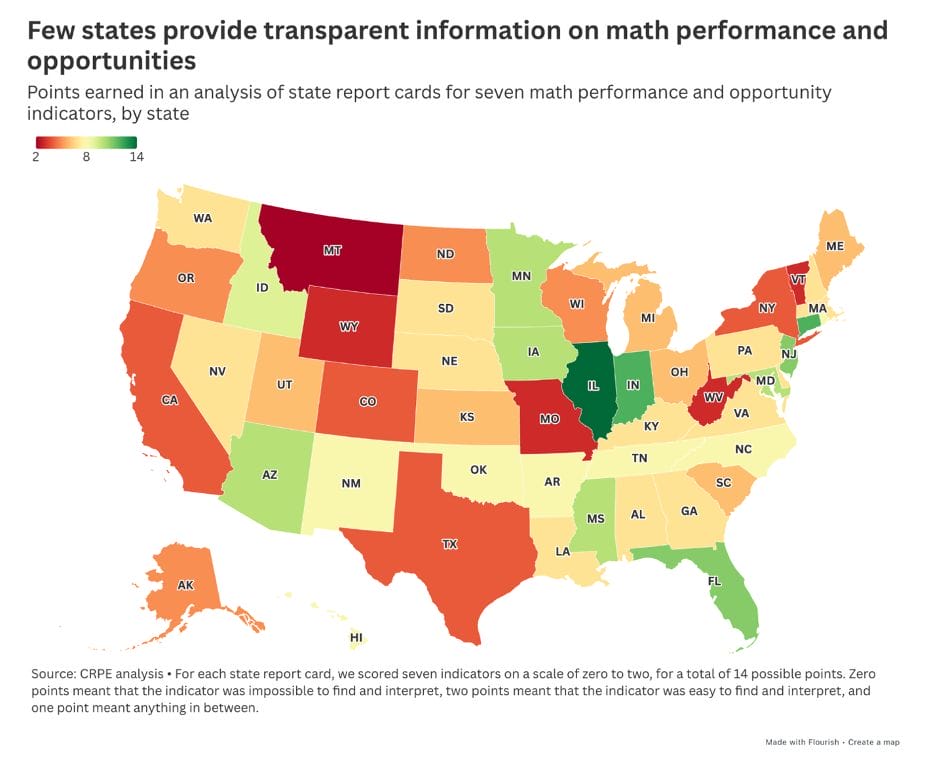
Very few states provide transparent information on math performance and opportunities. So what does that mean for educators, policymakers and families?
Transparent and user-friendly report cards are a basic but essential tool, and right now, too many states are falling short.
“The numbers tell one story. It looks rosier than the story that students tell.”
This map shows how few states provide clear, transparent information about math performance and opportunity.
Some states make it relatively easy for families to understand how students are doing.
Others make it nearly impossible to interpret.
And that matters more than we think.
Because when data isn’t transparent, accountability weakens.
But here’s what the map doesn’t show.
It doesn’t show the fourth grader who quietly decides math “just isn’t for me.”
It doesn’t show the middle schooler placed on a slower track without fully understanding what that means and how to get on a different track.
It doesn’t show the parent who senses something is off but can’t quite articulate it.
From national research and from our own experience at Wonder Math, we’ve collected countless stories. Not just about skill gaps, but about confusion, frustration, and quiet resignation.
Parents often tell us:
“I knew something wasn’t clicking, but I didn’t know what.”
Students tell us:
“I thought everyone else understood.”
When transparency is weak, families are left guessing.
When performance data isn’t accessible, intervention happens too late.
This is a key driver in the academic crisis. While the academic crisis is measurable, its emotional and psychological toll is harder to quantify.
The data tells us where proficiency is low.
The stories tell us where confidence is collapsing. Once this confidence collapses in elementary and middle school, it is very difficult for it to come back. Classes get harder and teachers move faster.
At Wonder Math, we live at the intersection of both.
We see the national trends reflected in individual children, and we also see how early, focused support can change a trajectory.
The map shows structural gaps.
The students show human ones.
Both deserve attention.
Source: A Crisis In Math. The State of The American Students 2025 https://crpe.org