
If you have ever watched your child stare at a math worksheet with a mix of confusion and despair, you aren’t alone. For many families, fractions represent the first real “wall” in a student’s academic journey. Up until this point, math followed a predictable set of rules: numbers got bigger when you added them, and they always represented whole, tangible things like three apples or five toy cars. Suddenly, the rules change, and “1/8” is somehow smaller than “1/4.”
This guide is designed to help you navigate that transition. We will explore why this shift is so challenging, break down the curriculum expectations for elementary school students, and provide a vetted list of resources and tutoring options to help your child regain their confidence.
Why Fractions Feel Like a Hurdle (And How to Lower It)
Fractions are often the gateway to higher-level mathematics. They are the foundation for decimals, percentages, ratios, and eventually, algebra. When a child struggles with fractions, it isn’t usually a lack of effort; it is a fundamental shift in how they view the world of numbers.
The Shift from Whole Numbers to Proportions
For the first few years of school, children live in the world of “discrete” counting. If you have four cookies and take away two, you have two left. Fractions require “proportional reasoning,” which is a much more abstract concept. A child has to understand that a single object can be broken into infinite pieces and that the value of a number is now relative to the “whole.”
Think of it like learning a new language. If you’ve spent years learning that “4” is a large, powerful number, it is jarring to be told that 1/4 is actually a tiny slice of the pie compared to 1/2. To lower this hurdle, we have to stop treating fractions as two separate numbers stacked on top of each other and start teaching them as a single value that represents a relationship.
Helping Fractions Finally “Click”
One of the biggest reasons students struggle with fractions is that they’re often taught as a set of rules to memorize instead of concepts to understand.
At Wonder Math, we take a different approach. Our live, teacher-led classes use stories, visual models, games, and discussion to help students understand why fractions work—not just how to solve the problem in front of them. When students understand the reasoning behind the math, they become more confident and are better prepared for future topics like decimals, percentages, and algebra 2.
Many parents tell us their child has their first real “aha!” moment with fractions after just a few lessons.
Understanding the Roadmap: Fractions by Grade Level
Mathematics is a scaffolding project. If a child misses a brick in the third-grade foundation of elementary math, the fifth-grade structure will inevitably feel shaky. Understanding what is expected at each level, from elementary through pre-algebra in middle school, helps you identify exactly where the “gap” in your child’s knowledge might be.
3rd Grade: The Introduction to Equal Parts
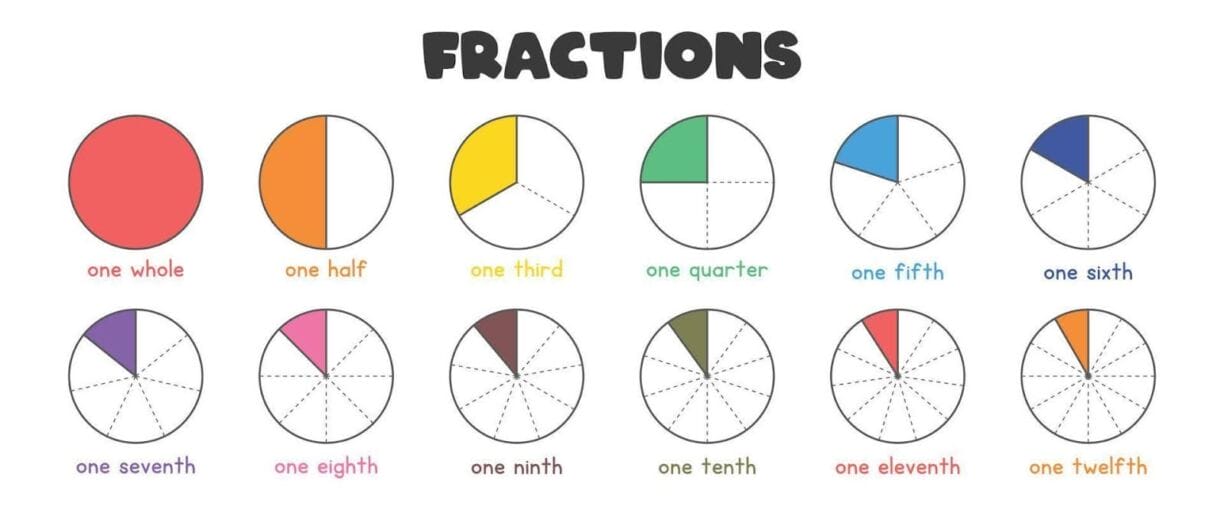
In third grade, the goal is exposure and visualization. Students move away from simply coloring in circles to understanding that a fraction is a point on a number line. They learn that the denominator (the bottom number) tells you how many equal parts the whole is divided into, while the numerator (the top number) tells you how many of those parts you are actually talking about. At this stage, the focus is on “unit fractions” like 1/2, 1/3, and 1/4.
4th Grade: Equivalent Fractions and Basic Operations
The complexity ramps up significantly in fourth grade. This is where students discover that 1/2, 2/4, and 4/8 are actually the same thing—this is the concept of equivalence. They also begin to add and subtract fractions with the same denominator. The biggest challenge here is often the transition to “improper fractions” (like 5/4) and understanding that a fraction can represent a value greater than one.
5th Grade: Mastering the Four Operations and Mixed Numbers
By fifth grade, the training wheels come off. Students are expected to add and subtract fractions with different denominators, which requires a solid grasp of multiplication and finding common multiples. They also dive into multiplying and dividing fractions. This is usually the point where students who relied on memorizing “tricks” instead of understanding fundamental math concepts begin to struggle, as the rules for multiplying (straight across) are different from the rules for adding (finding a common denominator).
Our Methodology: How We Vetted These Math Resources
Not all math apps and workbooks are created equal. In selecting the recommendations below, we prioritized three specific criteria:
- Conceptual Depth: Does the resource explain why something works, or does it just encourage rote memorization?
- Engagement Factor: Is it a “digital worksheet” (boring) or an interactive experience that rewards curiosity?
- Adaptability: Can the program identify a student’s specific weak points and adjust the difficulty accordingly?
Top Online Math Platforms for Interactive Learning
Digital platforms are excellent for providing immediate feedback, which prevents students from practicing a mistake twenty times before a teacher can correct it.
1. Khan Academy Kids and Khan Academy
Khan Academy remains the gold standard for free, high-quality education. For younger children (Pre-K to 2nd), Khan Academy Kids uses charming characters and stories to introduce the idea of sharing and equal parts. For older elementary students, the standard Khan Academy platform offers a mastery-based system. If your child misses a question on adding fractions, the system offers a specific video tutorial and hint-based practice until they truly understand the mechanism behind the answer.
2. Beast Academy (Art of Problem Solving)
If your child is a visual learner who loves stories, Beast Academy is a revelation. Instead of dry textbooks, it uses a graphic novel format featuring “monster” characters. It is designed by the Art of Problem Solving team, meaning it focuses on deep, challenging logic rather than repetitive drills. It’s perfect for kids who find standard school math boring but struggle with the “trickier” logic of fractions.
3. IXL Learning
IXL is the ultimate practice tool. It breaks down the math curriculum into thousands of micro-skills. If your child specifically struggles with “comparing fractions with unlike denominators,” you can find a dedicated module for exactly that. It provides a “SmartScore” that rewards accuracy over speed, ensuring that students aren’t just rushing to finish.
4. Prodigy Math Game
For the student who fights you every time the math book comes out, Prodigy is the “sugar-coated” solution. It is a fantasy role-playing game where players engage in “wizard battles” by solving math problems. While it is less instruction-heavy than Khan Academy, it is unparalleled at getting kids to do 30 minutes of math practice without realizing they are “working.”
Best Supplemental Programs and Workbooks
Sometimes, getting away from the screen is exactly what a child needs to focus. Physical workbooks allow for “scratch work” and the tactile experience of writing out problems.
1. Kumon Math Centers
Kumon is built on the philosophy of daily, incremental practice. It is highly structured and repetitive. While some find the “drill” method of repetitive practice problems tedious, it is incredibly effective for building “fluency”—the ability to solve problems quickly and accurately without overthinking. For a child who understands fractions but is “slow” or makes “silly mistakes,” Kumon builds the mental muscle memory needed to succeed.
2. Singapore Math (Dimensions Math)
The “Singapore Method” is world-renowned for its “Concrete-Pictorial-Abstract” approach. Before a child ever writes “1/4 + 1/4,” they work with physical blocks (concrete) and then draw diagrams (pictorial). This ensures that when they finally get to the numbers (abstract), they have a mental image of what is actually happening. The Dimensions Math series is their most modern and parent-friendly version.
3. Math-U-See
Math-U-See is a favorite among homeschooling families because it uses a specific set of color-coded “manipulatives” (blocks and overlays). For fractions, they use transparent overlays that allow students to physically lay one fraction over another to see how they combine or overlap. It is the most “hands-on” program on this list and is excellent for kinesthetic learners.
Personalized Support: Finding the Right Tutor
IIf your child is more than a grade level behind, has lost confidence in math, or simply needs a different teaching approach, personalized instruction and academic tutoring can make a tremendous difference.
1. Wonder Math
Wonder Math offers live online math tutoring through small-group classes that combine engaging stories, visual models, interactive games, and guided problem solving to help students truly understand math concepts—not just memorize procedures.
Instead of drilling the same worksheet over and over, students explain their thinking, collaborate with classmates, and receive immediate feedback from experienced teachers. Classes are grouped by grade level and ability, making it easier to fill learning gaps while keeping students challenged.
Wonder Math also offers a free trial class, allowing families to experience the program before enrolling.
2. Remind Tutoring
Known for its communication app used by schools, Remind Tutoring offers 40-minute online sessions with certified teachers. Because these tutors are actual educators, they understand the current “Common Core” methods being taught in classrooms, which prevents the frustration of a parent saying, “That’s not how I learned it!”
3. Paper.co
Many school districts now provide free access to Paper.co, which offers 24/7 on-demand tutoring. It isn’t a video call; instead, it’s a chat-based interface for instant homework help where students can upload a photo of their problems. The tutors are trained not to give the answer, but to ask Socratic questions that lead the student to the solution.
4. Local University Education Programs
A hidden gem for affordable tutoring is your local university’s Department of Education. College students training to be teachers often need practicum hours or are looking for part-time work. They are usually well-versed in the latest pedagogical strategies and can offer high-energy, relatable support for elementary students.
At-Home Strategies to Make Fractions “Click”
You don’t need a teaching degree to help your child understand fractions. You just need to bring math into the real world.
The Kitchen Laboratory: Baking with Halves and Quarters
The kitchen is the ultimate fraction lab. Give your child a recipe and tell them, “We need to double this,” or “We only have a 1/4 measuring cup; how many of these do we need to make 3/4 of a cup of flour?” Seeing a 1/2 cup measure actually hold two 1/4 cup measures is a powerful “lightbulb” moment that a worksheet can’t replicate.
Visual Aids: Using Manipulatives and Number Lines
Avoid teaching fractions in the air. Always have a visual aid nearby. Whether it’s a “fraction tile” set from Amazon or just drawing a long number line on a piece of sidewalk chalk, physicalizing the distance between zero and one helps students understand that a fraction is a real “place” on the map of numbers.
Language Matters: Saying “One Out of Four” vs. “One-Fourth”
When first starting, the term “one-fourth” can feel like a random name. Try using “one out of four equal parts.” This phrasing constantly reinforces the definition of a fraction. When you see “3/5,” call it “three pieces of a five-piece whole.” This linguistic bridge helps the brain connect the symbol to the concept.
When to Seek Professional Intervention
It is normal for a child to be frustrated by a new concept, but how do you know when it’s something more serious?
Identifying Math Anxiety vs. Learning Gaps
Math Anxiety often looks like a “shutdown.” If your child cries, refuses to look at the paper, or says “I’m just not a math person,” they are dealing with an emotional blockage. This requires confidence-building and low-stakes practice.
Learning Gaps, however, are more clinical. If your child is in 5th grade but still struggles to quickly recall multiplication facts (like 6 x 7), they will never be able to find common denominators effectively. In some cases, a persistent struggle with numbers might indicate Dyscalculia, a specific learning disability. If your child works hard but cannot seem to grasp the “size” of numbers or basic patterns, it may be time to speak with a school counselor about an evaluation.
When Practice Isn’t Enough
If your child continues struggling with fractions despite extra practice at home, it may be time for additional support.
The good news is that struggling with fractions doesn’t mean a child “isn’t a math person.” More often, it means they need instruction that matches how they learn best.
Programs like Wonder Math focus on building conceptual understanding through engaging lessons, teacher guidance, and interactive activities that help students connect ideas instead of memorizing steps.
Even one or two additional math sessions each week can dramatically improve confidence before those learning gaps grow larger.
The Long-Term Value of Fraction Fluency
It might feel like you are fighting a localized war over a worksheet about “shaded circles,” but the stakes are higher than a single grade. Mastering fractions is the moment a child stops “counting” and starts “reasoning.” It builds the proportional thinking required for geometry, statistics, cooking, carpentry, coding, and managing personal finances.
By using the right tools—whether it’s a gamified app like Prodigy, a tactile program like Math-U-See, or the patient guidance of a tutor—you are doing more than providing simple test prep or helping them pass a single exam. You are giving them the keys to the language of the modern world. Stick with it, keep it visual, and remember: even the most complex “improper” situation can be broken down into manageable parts.