

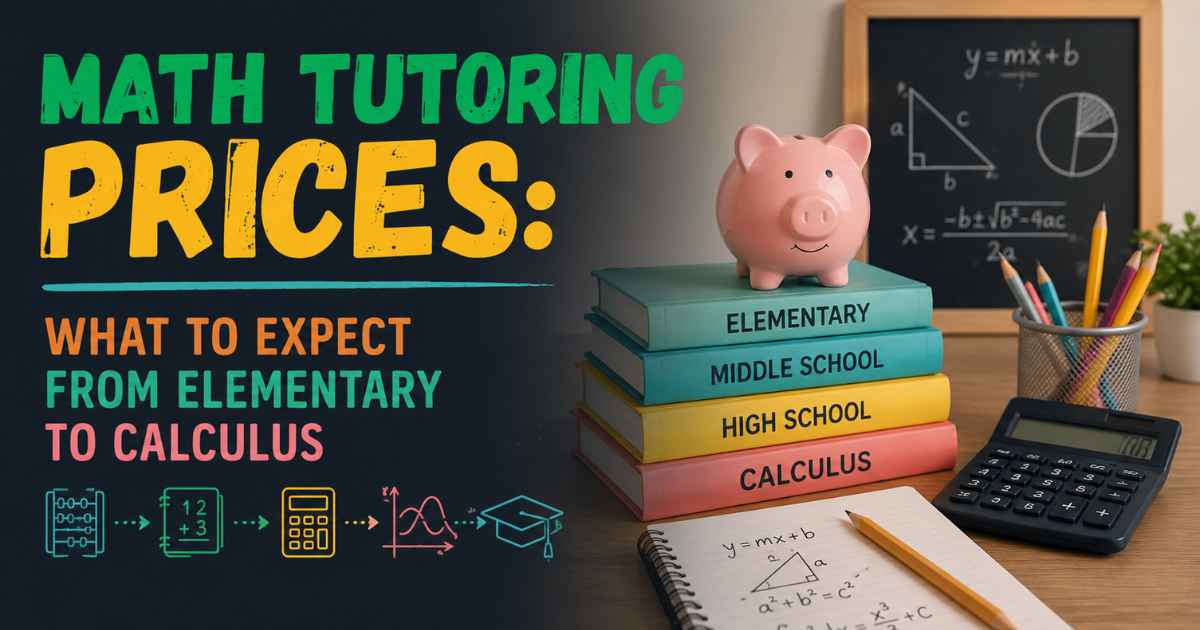
Finding the right math tutor often feels like solving a complex equation where the variables are constantly shifting. You want the best for your child—or your own GPA—but the price tags you encounter can range from the cost of a fast-food meal to the price of a fine dining experience.
The truth is, math tutoring isn’t a commodity or simple homework help; it’s an investment in cognitive infrastructure. Whether you are navigating the multiplication tables of third grade or the triple integrals of multivariable calculus, understanding the market landscape is the first step toward making a savvy financial and educational decision.
The Real Cost of Mastering Math: An Overview
On a broad scale, average tutoring rates in the United States typically fall between $30 and $100 per hour, though outliers exist on both ends. At the lower end, you’ll find high school peers or remote international services; at the higher end, you’ll find PhD-level specialists and elite test-prep consultants who may charge upwards of $200 per hour.
But looking at a single average is misleading. The “real” cost is a reflection of the tutor’s time, the tutor’s experience and specialized knowledge, and the specific academic stakes involved. If you are paying for a weekly session over a school year, you are looking at an annual investment of roughly $1,200 to $4,000. It’s a significant range, and where you land on that spectrum depends on several key levers.
Why Does Math Tutoring Pricing and math tutor rates Vary So Much?
Price variation in tutoring isn’t arbitrary. It follows the same economic principles that govern any other professional service. To get the best value, you have to understand what exactly you are paying for when a tutor quotes you a rate.
The Law of Supply and Demand in Specialized Subjects
Almost anyone with a high school diploma can help a fourth-grader with long division. The supply of potential tutors is massive, which keeps prices low. However, as the math becomes more abstract—think Differential Equations or Linear Algebra—the pool of qualified mentors shrinks dramatically. When you hire a tutor for advanced math subjects, you aren’t just paying for their hour of time; you are paying for the years they spent mastering a subject that most people find impenetrable.
Location and Cost of Living
Geography remains a primary driver of cost. A tutor in Manhattan or San Francisco faces significantly higher overhead and cost-of-living expenses than a tutor in a rural town. Even within the same city, “travel surcharges” can apply if a tutor is coming to your home. This is one reason why online tutoring has become a Great Equalizer, allowing a student in an expensive ZIP code to access high-quality instruction from a tutor living in a more affordable region.
The “Expertise Premium”: Experience vs. Certification
There is a distinct difference between a “math whiz” and a “math teacher.” A college student who aced Calculus might know the material, but they may lack the pedagogical tools to adapt to a student’s learning style and explain why a concept works to a struggling learner. Certified teachers or professional tutors with decades of experience command a premium because they possess a library of analogies, shortcuts, and psychological techniques to break through “math anxiety.” You are paying for efficiency: an expert might help a student master a concept in two sessions that a peer tutor might take five sessions to explain.
Pricing by Student Level: From Foundations to Advanced Theory
As a student progresses through the educational system, the complexity of the curriculum—and the cost to support it—tends to climb.
Elementary School: Building the Basics
At this level, the focus is on elementary math concepts like number sense, fractions, and basic operations. The goal is often confidence-building rather than intense academic rigor. You can expect to pay $30 to $50 per hour. Because the material is foundational, many parents opt for high school honors students or local college students as tutors, which keeps the price point accessible.
Beyond Traditional Tutoring: Math Enrichment Programs
Wonder Math is a good example of another option parents may want to consider, particularly for elementary and middle school students. Rather than focusing solely on homework help or fixing an immediate academic problem, Wonder Math uses live online instruction to help students strengthen foundational math skills while building confidence and a more positive relationship with math.
For families whose child isn’t necessarily failing math but could benefit from additional instruction, practice, or challenge, a structured program like Wonder Math can offer an alternative to traditional one-on-one tutoring. Students learn with a live teacher in an interactive environment designed to make math engaging while continuing to build the skills they’ll need as concepts become more advanced.
Middle School: The Transition to Pre-Algebra
Middle school math is often where the “math wall” appears. Concepts become more abstract as students move toward Algebra I. Tutors here need to be able to bridge the gap between concrete arithmetic and symbolic logic. Rates typically nudge upward to $45 to $65 per hour. At this stage, parents often start looking for tutors with a bit more formal experience, as the “new math” methodologies used in schools can be confusing for even well-meaning parents to teach.
High School: Geometry, Algebra II, and Trig
In high school, the stakes rise with GPA requirements and college applications. The subject matter becomes specialized. A tutor must be comfortable with the logic proofs of Geometry and the complex functions of Algebra II. Expect to pay $60 to $90 per hour for a qualified professional. At this level, you are often paying for someone who understands the specific curriculum of the local school district.
The Calculus and Advanced Placement (AP) Price Jump
This is the most significant pricing threshold. AP Calculus AB/BC and AP Statistics require a tutor who not only understands the math but also knows the specific “tricks” and formatting requirements of the College Board exams. Because this is a high-demand, high-skill niche, rates frequently jump to $80 to $120+ per hour.
College-Level and Graduate Mathematics
When you enter the realm of Real Analysis, Abstract Algebra, or advanced physics like Quantum Mechanics, you are no longer looking for a “tutor”—you are looking for a colleague or a mentor. These specialists are often adjunct professors or PhD candidates. Rates here rarely start below $100 per hour and can easily double depending on the rarity of the expertise required.
Comparing Formats: In-Person vs. Online Tutoring
The format you choose dictates not just the price, but the dynamic of the learning experience.
Local In-Person Tutoring: The Premium Choice
In-person tutoring is generally the most expensive option. You are paying for the tutor’s travel time, gas, and the physical presence that helps keep a younger or easily distracted student on task. While it offers the highest level of engagement and “hands-on” correction, you are limited to the talent pool within a 10-mile radius.
Online Tutoring: Flexibility and Competitive Rates
Online tutoring platforms have evolved far beyond simple Skype calls. With digital whiteboards and screen-sharing, it is incredibly effective for math. Generally, online rates are 15% to 25% lower than in-person rates because the tutor has zero commute time. It also allows you to shop globally; a student in London can work with a tutor in Ohio, finding the perfect balance of expertise and price.
Group Tutoring vs. One-on-One Sessions
If one-on-one rates are prohibitive, group sessions (usually 3–5 students) can cut costs by 40% to 60%. This works well for students who are roughly at the same level and are working through the same textbook. However, you lose the “targeted” nature of tutoring; the tutor won’t be able to pause the whole group just because one student is stuck on a specific step.
Professional Tutoring Centers vs. Private Freelancers
Who you hire is just as important as what they teach. The “business model” of the tutor significantly impacts your monthly bill.
Large Learning Centers (Kumon, Mathnasium, Sylvan)
Franchises like Mathnasium or Kumon typically use a subscription-based model rather than an hourly one. You might pay $200 to $400 per month for two sessions a week.
- Pros: Structured curriculum, consistent environment, and a “gym-like” approach to math.
- Cons: You aren’t always getting one-on-one attention; the “tutor” often rotates between 2–3 students simultaneously.
The Independent Freelancer (University Students and Peers)
This is usually the most budget-friendly route. A local college student might charge $25 to $40 per hour.
- Pros: Low cost, relatable “big brother/sister” energy.
- Cons: Reliability can be an issue (finals week for them means no tutoring for you), and they may lack the formal training to explain concepts to a struggling learner.
The Professional Private Tutor (Certified Teachers)
These are the heavy hitters. They often have 10+ years of classroom experience and tutored hundreds of students.
- Pros: They know exactly where students typically trip up; they have supplemental materials ready to go.
- Cons: Highest hourly rates ($75–$150) and often have a waiting list.
Live Online Math Programs
Programs such as Wonder Math offer a middle ground between a traditional tutoring center and hiring a private tutor. Students receive live instruction from a teacher online, eliminating travel while still providing the structure, curriculum, and consistency that families often want from an established math program.
Unlike traditional homework-focused tutoring, programs like Wonder Math can also focus on developing the student’s underlying math skills and confidence rather than simply helping them complete that week’s assignment.
The Impact of Test Prep: SAT and ACT Math Surcharges
It is important to distinguish between academic tutoring (helping a student pass Algebra) and test-prep tutoring (helping a student beat the SAT or GRE). Test prep is often priced as a premium service because it involves strategy, timing, and “gaming” the test as much as it involves actual math.
Specialized test-prep companies often charge 20% to 50% more for an SAT math session than a standard high school math session. When you hire for test prep, you are paying for the tutor’s knowledge of the specific test’s quirks and their ability to move a student’s score by a specific number of points.
Hidden Costs to Watch Out For
The hourly rate isn’t always the “all-in” price. Before signing a contract, look for these common hidden variables.
Travel Fees and Minimum Session Lengths
Some tutors charge a flat “travel fee” (e.g., $10 per visit) if they have to drive to you. Others may have a 90-minute minimum session length. If you were planning on a quick 45-minute brush-up, a 90-minute minimum effectively doubles your expected cost.
Assessment and Registration Fees
Learning centers almost always charge an initial “diagnostic fee” to assess the student’s level. This can range from $50 to $150. While it provides a helpful baseline, it’s an upfront cost that doesn’t go toward actual instruction time.
Cancellation Policies and Retainer Models
Professional tutors usually require 24 to 48 hours’ notice for cancellations. If you forget or have a last-minute schedule change, you will likely still be billed for the full hour. Some high-end tutors also use a “retainer” model where you pay for the entire month upfront to hold your time slot, regardless of whether you use every session.
How to Get the Best Value for Your Money
Higher prices don’t always mean better results. You can optimize your spending by being strategic about how you engage with a tutor.
Bundling Sessions for Discounts
Many independent tutors and online platforms offer a discount if you buy “packages” or similar package deals. For example, an $80/hour rate might drop to $70/hour if you prepay for 10 sessions. This is a great way to save if you know you’ll need support for the entire semester.
Off-Peak Scheduling
Tutors are busiest on weekday afternoons (3:00 PM to 7:00 PM). If you are a college student or a homeschooled student who can meet at 10:00 AM on a Tuesday, you might be able to negotiate a lower “off-peak” rate with an independent tutor.
Focusing on “Learning to Learn”
The most expensive way to use a tutor is as a “homework machine”—someone who just sits there while the student does their homework and helps them get the right answers. The most cost-effective way is to focus on meta-cognition. Ask the tutor to teach the student how to take notes, how to use their textbook, and how to check their own work. The goal should be to “fire” the tutor once the student has the tools to work independently.
Questions to Ask a Math Tutor Before You Hire Them
To ensure your money is being well-spent, vet your candidates and their tutor qualifications with these specific questions:
- “What is your specific experience with [Subject, e.g., Algebra II]?” You want someone who has taught the specific curriculum your student is facing.
- “Do you provide your own practice materials or do we use the school’s?” A great tutor has a “toolbox” of extra worksheets and visual aids.
- “How do you handle a student who is ‘stuck’ or frustrated?” This reveals their pedagogical approach and patience.
- “Can you provide a brief summary after each session?” Communication is key to tracking ROI.
- “What is your policy on tech issues?” (For online tutoring) Ensure you aren’t paying for 15 minutes of “Can you hear me now?”
Making the Investment: Is Math Tutoring Worth It?
Math is a cumulative subject. If a student misses a “brick” in the wall during fifth grade, the entire structure becomes unstable by the time they reach tenth grade. This is why math tutoring is often more of a necessity than a luxury.
When you look at the price, consider the “cost of failure.” Retaking a college course, summer school fees, or the psychological toll of feeling “bad at math” can be far more expensive than a dozen tutoring sessions. By choosing the right format and level for your specific needs, you aren’t just paying for a higher test score—you’re paying for the confidence that comes from finally understanding the language of the universe. Wondering whether Wonder Math is the right fit for your child? Try a free Wonder Math class and see how your child responds to a different approach to learning math.

