

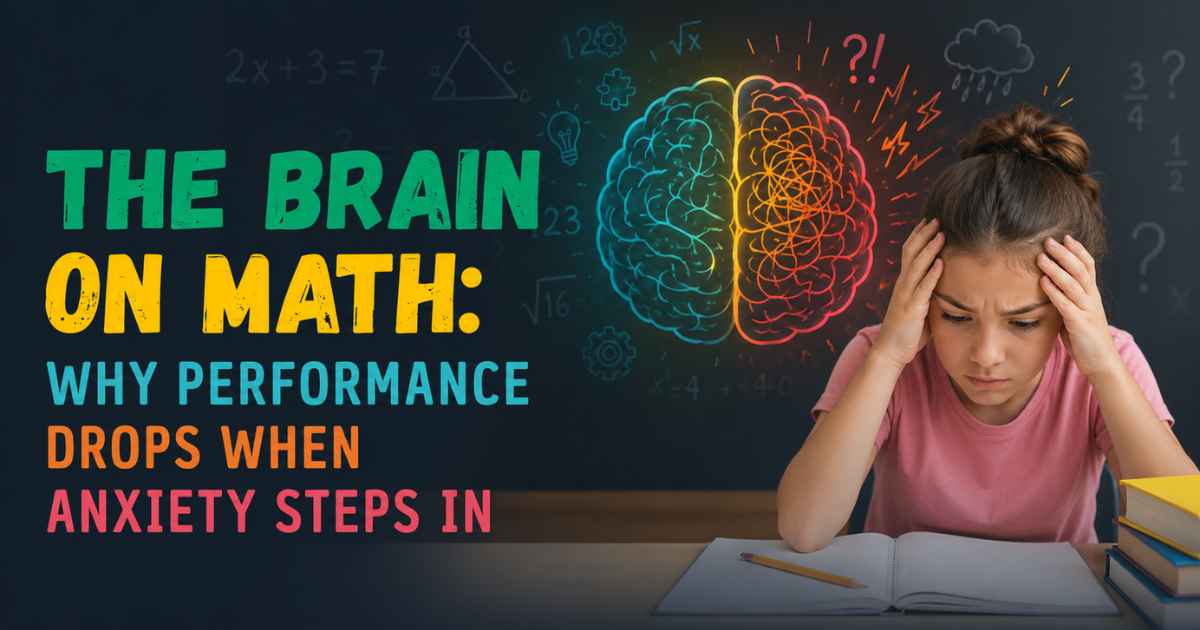
For many students, the mere sight of a long-division bracket or a complex algebraic equation doesn’t just represent a challenge; it triggers a physiological emergency. If you have ever watched a bright, capable child suddenly “go blank” during a math test, you aren’t witnessing a lack of intelligence or a failure of preparation. You are witnessing a neurological shutdown. This phenomenon, known as math anxiety, is a legitimate psychological condition that acts as an invisible barrier between a student’s true potential and their academic performance.
Understanding math anxiety is the first step toward dismantling it. It isn’t just “being bad at numbers” or a learning disability like dyscalculia. It is a specific tension and apprehension that interferes with the manipulation of numbers and the solving of mathematical problems in a wide variety of ordinary life and academic situations. To help a child overcome this, we must look past the red ink on a report card and peer into the mechanics of the brain under pressure.
The Invisible Wall: Understanding Math Anxiety in the Classroom
Imagine a student named Leo. In a relaxed setting, Leo can tell you exactly how much change he should get back from a five-dollar bill. But the moment his teacher announces a timed multiplication quiz, Leo’s palms sweat, his heart races, and he suddenly can’t remember what five times eight is. This is the “Invisible Wall.”
Math anxiety creates a cognitive tax. It is a secondary task that the brain has to perform simultaneously with the actual math. While a relaxed student can devote 100% of their mental energy to solving a problem, an anxious student is using 50% of their energy to solve the problem and the other 50% to manage their fear, self-doubt, and physical discomfort. This “wall” is often misinterpreted by educators as a lack of ability, which leads to a devastating cycle: the student performs poorly because they are anxious, and they become more anxious because they performed poorly.
The Biological Hijack: What Happens to the Brain During Math Anxiety?
When a child with math anxiety sits down to a test, their brain isn’t just thinking about numbers; it’s reacting to a perceived threat. This isn’t a metaphor—it is a measurable biological event. Neurological studies using fMRI scans have shown that for highly math-anxious individuals, the brain’s response to seeing a math problem is strikingly similar to the response triggered by physical pain or a direct threat from a predator.
The Amygdala and the “Fight or Flight” Response
The primary culprit in this biological hijack is the amygdala, the brain’s emotional processing center. The amygdala is designed to keep us safe. In the wild, if you see a bear, the amygdala sends an alarm signal that shuts down non-essential functions (like digestion or deep philosophical thought) to prioritize survival.
In the classroom, math becomes the bear. When the amygdala senses the “danger” of a math problem, it floods the body with cortisol and adrenaline. This triggers the fight-or-flight response. The child’s heart rate increases, and their breathing becomes shallow. Because the brain is now in survival mode, it de-prioritizes the prefrontal cortex—the area responsible for logical reasoning and complex problem-solving. Essentially, the part of the brain needed to do math is being actively suppressed by the part of the brain trying to “save” the child from the math.
The Working Memory Crunch: Why Mental Math Suddenly Becomes Impossible
The most damaging effect of this neurological hijack occurs in the working memory. Think of working memory as the brain’s “mental scratchpad.” It is the limited-capacity system that allows us to hold and manipulate information in our heads temporarily—like carrying a digit during addition or remembering the next step in a multi-step word problem.
Research by Dr. Sian Beilock, a leading cognitive scientist, suggests that math anxiety specifically targets and “drains” working memory. The intrusive, worrisome thoughts (“I’m going to fail,” “Everyone else is faster than me”) take up space on that mental scratchpad. Because working memory is a finite resource, there isn’t enough room left to perform the actual calculations. This is why a student might know their formulas perfectly during homework but find them inaccessible during a high-stakes exam.
The Evidence: What Academic Studies Tell Us About Performance
The relationship between anxiety and performance isn’t just anecdotal; it is backed by decades of rigorous academic study. Researchers have consistently found a negative correlation between math anxiety and math achievement across all age groups, from primary school to university.
The Reciprocal Theory: A Feedback Loop of Failure
One of the most significant findings in recent literature is the “Reciprocal Theory.” For years, researchers debated whether anxiety causes poor performance or if poor performance causes anxiety. Current evidence suggests it is both. This creates a self-perpetuating feedback loop.
A student who struggles with foundational concepts (like fractions) may develop anxiety because the subject is difficult. This anxiety then reduces their working memory capacity, making it even harder to learn more complex concepts (like algebra). As the gap between their ability and the curriculum grows, their anxiety intensifies, leading to further avoidance of math, which ensures their math skills remain stagnant. Breaking this loop requires addressing both the emotional response and the skill deficit simultaneously.
The Impact on Standardized Testing and Longitudinal Success
The stakes of math anxiety extend far beyond a single classroom. Longitudinal studies show that students with high math anxiety are less likely to pursue STEM (Science, Technology, Engineering, and Math) careers, regardless of their actual innate intelligence.
On standardized tests, the pressure of the clock exacerbates the “working memory crunch.” Studies have shown that if you remove the time limit, the performance gap between high-anxiety and low-anxiety students often narrows significantly. This suggests that these tests are frequently measuring a student’s level of anxiety rather than their actual mathematical proficiency. Over time, this leads to lower grades, reduced confidence, and a lifelong avoidance of anything involving numbers.
Identifying the Symptoms Beyond the Report Card
As a mentor or parent, it is vital to recognize that math anxiety doesn’t always look like a child crying over a textbook. It is often much more subtle, manifesting as a series of defensive maneuvers or physical ailments.
Physical Manifestations of Cognitive Stress
Children may not have the vocabulary to say, “I am experiencing a cognitive load issue.” Instead, they will complain of a stomachache or a headache right before a math lesson. You might notice them fidgeting excessively, picking at their skin, or displaying a sudden need to leave the room for water or a bathroom break. These aren’t necessarily “excuses” to get out of work; they are the physical results of the cortisol spike we discussed earlier. The body is literally in distress.
Psychological Red Flags: Avoidance and Negative Self-Talk
The psychological and physical symptoms often involve “task avoidance.” This might look like a child spending twenty minutes sharpening pencils or organizing their desk instead of starting their homework. When they do engage, listen to their language. Phrases like “I’m just not a math person” or “My brain doesn’t work this way” are red flags. This type of negative self-talk acts as a protective shield; by deciding they “can’t” do math, they provide themselves with an excuse for the failure they feel is inevitable, thereby protecting their ego from the pain of trying and failing.
The Roots of the Problem: How Math Anxiety Develops
Math anxiety isn’t an innate trait; no one is born with a fear of numbers. It is a learned response, often cultivated by the environment in which math is taught and discussed.
The Role of Teacher and Parent Attitudes
One of the most surprising findings in education research is the “contagion” effect of math anxiety. Studies have shown that when teachers or parents harbor their own anxieties about math, they can inadvertently pass those feelings on to their children. If a parent says, “Don’t ask me for help with your homework, I was always terrible at math,” they are signaling to the child that math is a frightening, insurmountable obstacle. Similarly, if a teacher displays frustration or impatience when a child doesn’t grasp a concept quickly, it reinforces the “math is danger” narrative in the student’s amygdala.
The “Math Person” Myth and Cultural Stereotypes
We live in a culture that treats mathematical ability as a fixed trait—like eye color—rather than a muscle that grows with exercise. This is the “Math Person” myth. When a child struggles with reading, we encourage them to practice more. When they struggle with math, we often hear, “It’s okay, I’m not a math person either.” This cultural acceptance of low numeracy and math illiteracy provides a fertile ground for anxiety. Furthermore, stereotypes regarding gender or race and mathematical ability can create “stereotype threat,” where a student feels the added pressure of representing their entire group, further taxing their working memory.
Timed Testing and the Pressure of Speed
Perhaps no single factor contributes more to classroom anxiety than the “mad minute” or timed fluency tests. While the goal is to encourage automaticity, the effect for many is pure panic. When speed is equated with intelligence, students who are deep, slow thinkers begin to believe they are “bad” at math. The ticking clock is the ultimate amygdala trigger, ensuring that the very students who need their working memory the most are the ones who lose access to it first.
Evidence-Based Strategies to Reclaim Cognitive Space
The good news is that the brain is plastic. We can retrain the neurological response to math and “clear” the working memory so that learning can happen.
Expressive Writing: Clearing the Mental Fog Before an Exam
One of the most effective, research-backed interventions is surprisingly simple: writing. Dr. Sian Beilock’s research found that when students spent 7 to 10 minutes writing down their fears and worries about an upcoming math test, their scores improved significantly.
Why does this work? It’s called “externalizing.” By putting the worries onto paper, the student “downloads” them from their working memory. This clears up mental space, allowing the brain to focus entirely on the math problems rather than the fear of failing.
Mindfulness and Focused Breathing to Calm the Amygdala
Since math anxiety is a physiological “hijack,” we must use physiological tools to combat it. Teaching a child simple diaphragmatic breathing—deep breaths that expand the belly—can signal the nervous system to shift from the sympathetic (fight or flight) to the parasympathetic (rest and digest) state. When the heart rate slows and oxygen flows, the amygdala stands down, and the prefrontal cortex comes back online.
Reframing “Anxiety” as “Excitement”
The physical sensations of anxiety (racing heart, sweaty palms) are almost identical to the sensations of excitement. Studies have shown that when students tell themselves “I am excited” instead of “I am calm” before a task, they perform better. Trying to force “calmness” when your body is flooded with adrenaline is difficult. However, reframing that energy as “arousal” or “readiness” helps the brain channel the adrenaline into the task at hand rather than fighting against it.
Creating a Supportive Environment at Home and School
To truly eradicate math anxiety, we must change the “atmosphere” surrounding the subject. Math should be presented as an exploration, not a performance.
The Power of Growth Mindset Over Rote Memorization
Shifting to a “Growth Mindset”—the belief that intelligence can be developed—is crucial. We should praise the process, the effort, persistence, and the strategy rather than the “correctness” of the answer. When a child makes a mistake, treat it as a “beautiful struggle.” Mistakes are the moments when the brain is actually growing the most. By de-emphasizing the “right” answer and celebrating the logic used to get there, we lower the stakes and reduce the fear of failure.
Low-Stakes Practice and Gamification
One way to rebuild a relationship with math is through low-stakes engagement. Games like Sudoku, logic puzzles, or math-based board games allow children to interact with numbers in a context where there is no red pen and no ticking clock. Gamification—using apps that reward progress and allow for “do-overs”—can help re-wire the brain to see math as a series of solvable challenges rather than a series of threats.
How We Evaluated the Research for This Guide
In crafting this guide, we prioritized peer-reviewed longitudinal studies, meta-analyses of educational psychology, and neurobiological research. We specifically looked at the work of Dr. Sian Beilock (University of Chicago/Dartmouth), the PISA (Programme for International Student Assessment) reports on global math anxiety trends, and the “Intergenerational Transmission of Math Anxiety” studies. Our goal was to synthesize the bridge between what happens in the laboratory (fMRI scans and cognitive testing) and what happens at the kitchen table during homework time.
Moving Forward: Math as a Skill, Not a Sentence
Math anxiety is not a life sentence. It is a temporary neurological state that can be managed, mitigated, and eventually overcome. By understanding that a child’s struggle with math is often an emotional and biological hurdle rather than an intellectual one, we can change our approach.
When we replace the “Math Person” myth with the reality of neuroplasticity, and when we trade timed pressure for expressive writing and mindfulness, we do more than just improve test scores. We give a child back their confidence. We open doors to careers and opportunities they might have otherwise slammed shut. Math is a language of the universe—a skill that belongs to everyone. With the right support, every child can learn to speak it without fear.