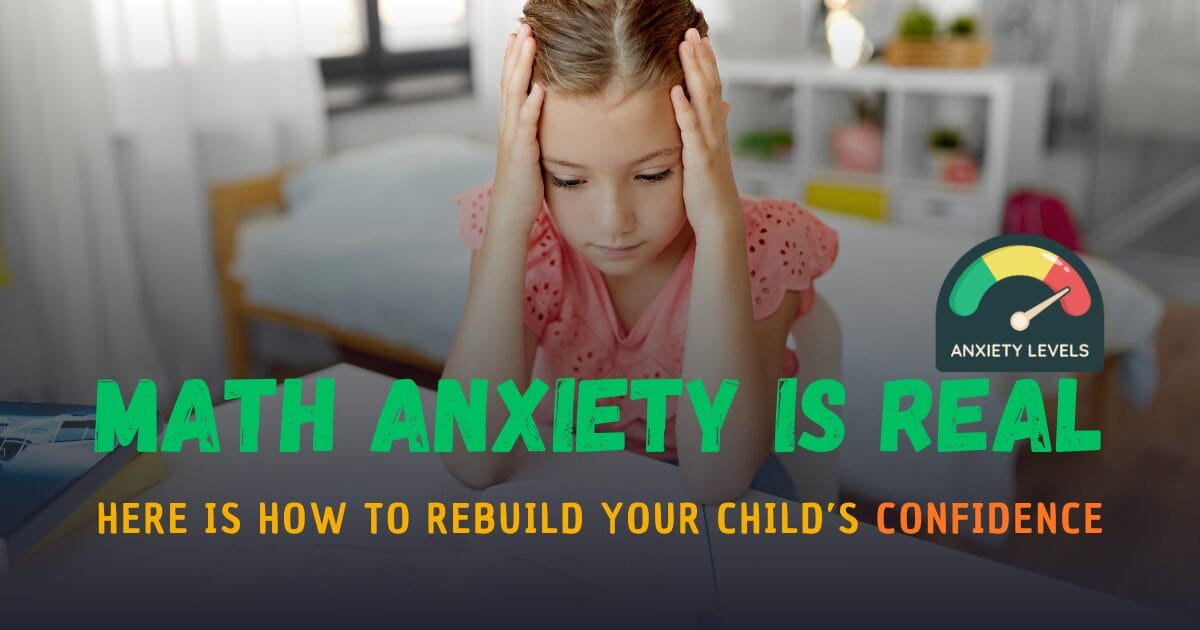


Mathematics has a unique way of making otherwise brilliant students feel suddenly powerless. It is rarely the numbers themselves that cause the panic; it is the weight of expectation, the fear of math, and the dread of a “wrong” answer. When a student sits down to solve a quadratic equation or a word problem involving ratios, they aren’t just fighting the logic of the problem—they are fighting a physiological response that clouds their thinking.
To help a student excel, we must first recognize that math proficiency is not a genetic trait. It is a psychological state. By focusing on confidence as the primary driver of competence and math achievement, we can transform the subject from a source of dread into a toolkit for empowerment.
The Silent Barrier: Why Math Confidence Matters More Than Talent
In most subjects, if you don’t understand a concept immediately, you simply read more or look up a definition. In math, however, a single misunderstanding can feel like a personal indictment. This is the “silent barrier” that prevents students from reaching their potential. It isn’t a lack of talent or fundamental math skills; it’s a lack of psychological safety.
The myth of the “math person”
We live in a culture that treats mathematical ability like a superpower you are either born with or you aren’t. We hear adults say, “I’m just not a math person,” with a shrug of resignation, as if they were describing their eye color. This is a damaging myth. Mathematics is a language of patterns and logic, and like any language, it is learned through exposure and practice. When a student believes they lack the “math gene,” adopting a negative math identity, they stop trying at the first sign of difficulty. They view struggle not as a sign of learning, but as proof of their inherent inadequacy.
How math anxiety creates a cognitive bottleneck
When a student feels test anxiety or feels generally anxious about math, their brain undergoes a literal physical change driven by mathematical anxiety. Anxiety triggers the amygdala—the brain’s emotional center—which highjacks the working memory needed to solve the problem. Think of your working memory like a small workbench. To solve a multi-step equation, you need every inch of that workbench to hold numbers, signs, and rules. Anxiety is like a pile of heavy bricks dumped onto that workbench; there’s no room left for the actual math. The student isn’t “bad at math”; they are simply working with a crowded brain. To fix the performance, we must first clear the bricks.
Strategy 1: Rewrite the Inner Narrative
The first step in building self-confidence is changing the internal dialogue. A student who tells themselves “I can’t do this” is essentially giving their brain permission to shut down. We need to replace that defeatist monologue with a narrative of incremental progress.
Shifting from a fixed to a growth mindset
Renowned psychologist Carol Dweck’s research into the “growth mindset” is the cornerstone of math confidence. A fixed mindset believes intelligence is static; a growth mindset understands that the brain is like a muscle that grows stronger with effort. In math, this means praising the process rather than the result. Instead of saying, “You’re so smart for getting that right,” we should say, “I’m impressed by how you tried three different methods until one worked.” This teaches the student that their value lies in their persistence, not just their speed or accuracy.
The power of “yet” in the classroom and at home
One of the simplest yet most transformative tools in a student’s arsenal is a three-letter word: yet. When a student sighs and says, “I don’t get fractions,” the response should always be, “You don’t get fractions yet.” This small linguistic shift signals to the subconscious that the current state of confusion is temporary. It frames the struggle as a middle point on a journey rather than a dead end.
Strategy 2: Master the Fundamentals (Filling the Cracks in the Foundation)
Math is a vertical subject. You cannot build a second floor if the first floor is missing its support beams. Many students who struggle with high school algebra aren’t actually struggling with algebra; they are struggling with the fractions and decimals they half-learned in fourth grade.
Why math is a cumulative mountain
Imagine trying to read a complex novel if you weren’t quite sure what the letter ‘R’ sounded like. You might stumble through, but the effort would be exhausting and the meaning would be lost. Math works the same way. If a student hasn’t mastered their multiplication tables, every long division problem becomes a grueling marathon of mental energy. By the time they reach the core concept of the lesson, they are already mentally depleted.
Identifying and attacking prerequisite gaps
To build unstoppable confidence, we must be willing to go backward to move forward. This requires a “gap analysis.” If a student is failing at ratios, go back and check their understanding of division. If they can’t handle variables, check their comfort level with basic arithmetic. Finding these “cracks in the foundation” and filling them with focused practice provides an immediate confidence boost. Suddenly, the “hard” math feels easy because the underlying mechanics are finally fluid.
Strategy 3: Embrace the “Beautiful Struggle” of Mistakes
In many subjects, a mistake is a sign that you weren’t paying attention. In math, a mistake is a diagnostic tool. We need to move away from the “red pen” culture that treats errors as failures and toward a culture that treats them as data points.
Normalizing error as data, not failure
When a scientist runs an experiment and it fails, they don’t throw their hands up and quit science; they look at the result to see what went wrong. We must teach students to do the same. When a problem is incorrect, the goal shouldn’t be to erase it and try again immediately. The goal should be to find the exact “point of departure”—the specific line where the logic veered off course. This turns the student into a detective rather than a victim.
The 10-minute struggle rule
Confidence is built when a student realizes they can survive frustration. Implementing a “10-minute struggle rule” can be incredibly effective. Encourage the student to sit with a difficult problem for ten minutes without asking for help. They can draw it, look at old notes, or try different operations. Even if they don’t solve it, they are building “intellectual calluses.” They are proving to themselves that confusion isn’t an emergency—it’s just the feeling of the brain growing.
Strategy 4: Use Visual and Concrete Models Before Abstraction
Standard math instruction often jumps straight into symbols and numbers. For many students, these are just meaningless squiggles on a page. To build real confidence, we need to ground those symbols in the physical world.
Moving from physical manipulatives to mental images
Before asking a student to solve $1/2 \times 1/4$ on paper, have them fold a piece of paper in half, and then half again. Let them see the result. By using “manipulatives”—physical objects like blocks, coins, or even slices of pizza—we provide the brain with a concrete anchor. Once they understand the physical reality of the math, the abstract symbols become much less intimidating.
Why drawing the problem changes the brain’s approach
Drawing is a bridge between the concrete and the abstract. When a student reads a word problem, their first instinct is often to pluck out the numbers and guess at an operation (addition? subtraction?). Instead, encourage them to “draw the story.” If a car is traveling at 60 mph, draw the car and the road. This engages the visual processing centers of the brain, often revealing the solution path that numbers alone couldn’t show.
Strategy 5: Implement Low-Stakes Retrieval Practice
Confidence is the child of competence. One of the fastest ways to build competence is through retrieval practice—the act of forcing your brain to recall information without looking at your notes.
The confidence boost of “easy wins”
Begin every study session with three or four “easy wins”—problems the student already knows how to solve. This warms up the “math muscles” and creates a positive momentum. It proves to the student that they do know things, which lowers their anxiety before they tackle the newer, harder material.
Flashcards and brain dumps over passive re-reading
Many students “study” by looking over their notes or re-reading a textbook. This creates an “illusion of competence”—they recognize the material, so they think they know it. But recognition is not the same as recall. Instead, have them do a “brain dump”: give them a blank sheet of paper and ask them to write down everything they remember about a concept. This active retrieval strengthens the neural pathways and ensures that when the test starts, the information is actually accessible.
Strategy 6: Relate Math to the Real World (Finding the “Why”)
“When am I ever going to use this?” is the universal cry of the frustrated math student. If math feels like a series of arbitrary puzzles, it’s hard to stay motivated. If it feels like a secret code for understanding the world, it becomes exciting.
Gamification and practical application
Math is the engine under the hood of everything a student loves. Do they like sports? Use statistics to compare their favorite players. Do they like cooking? Double a recipe using fractions. By gamifying these moments, we remove the “academic” pressure and replace it with curiosity. The goal is to show that math isn’t a school subject; it’s a life skill.
Connecting interests—from sports stats to Minecraft logic
For younger students, video games like Minecraft are masterclasses in geometry and logic. For older students, the algorithms behind TikTok or the physics of a skating trick can be the hook. When a student sees that math is the key to mastering their own interests, their confidence grows because the subject suddenly has a purpose.
Strategy 7: Teach it to Someone Else
The ultimate test of confidence and competence is the ability to explain a concept to another person. This is known as the “Protégé Effect.”
The Protege Effect: Learning through instruction
When we prepare to teach, our brains organize information more logically and deeply. Encourage students to “teach” a concept back to you. They shouldn’t just show you the answer; they should explain the why behind each step. If they stumble, don’t correct them immediately—let them find the hole in their own logic.
Encouraging “math talk” and verbalizing logic
Verbalizing math takes it out of the realm of “magic” and into the realm of “reasoning.” Ask questions like, “How did you know to do that?” or “What would happen if this number were negative?” By talking through the logic, the student reinforces their own understanding of mathematical problem solving and realizes that they aren’t just guessing—they are thinking.
The Role of the Support System
Building math confidence is a team effort. The environment at home and the attitude of the adults involved play a massive role in a student’s success.
How parents can avoid passing on “math trauma”
Math anxiety is contagious. If a parent says, “I was never good at math either,” they are unintentionally giving the student a “get out of jail free” card for giving up. Instead, parents should model curiosity. Even if you don’t know the answer, say, “I’m not sure how to do this yet, but let’s figure out the first step together.” Show them that being stuck is a puzzle to be solved, not a reason to panic.
Creating a low-stress environment for homework
Every homework assignment should be a place for practice, not a high-stakes performance. Keep the atmosphere light. If the tension starts to rise, take a five-minute “brain break.” Ensure the workspace is organized and free of distractions. Most importantly, focus on the effort and the “aha!” moments rather than the number of correct answers. A low-stress environment allows the working memory to stay clear and focused.
Summary: The Path to a Fearless Math Future
Building math confidence isn’t about memorizing more formulas; it’s about changing the student’s relationship with struggle. It’s about teaching them that a mistake is just a turn on the road to mastery and that their brain is fully capable of growth.
By rewriting the inner narrative, filling in foundational gaps, and embracing the “beautiful struggle” of learning, we can help students dismantle the silent barrier of anxiety. When a student realizes that math is a skill they can build rather than a talent they lack, they become unstoppable. The goal isn’t just to produce students who can solve equations—it’s to raise thinkers who aren’t afraid of a challenge.