

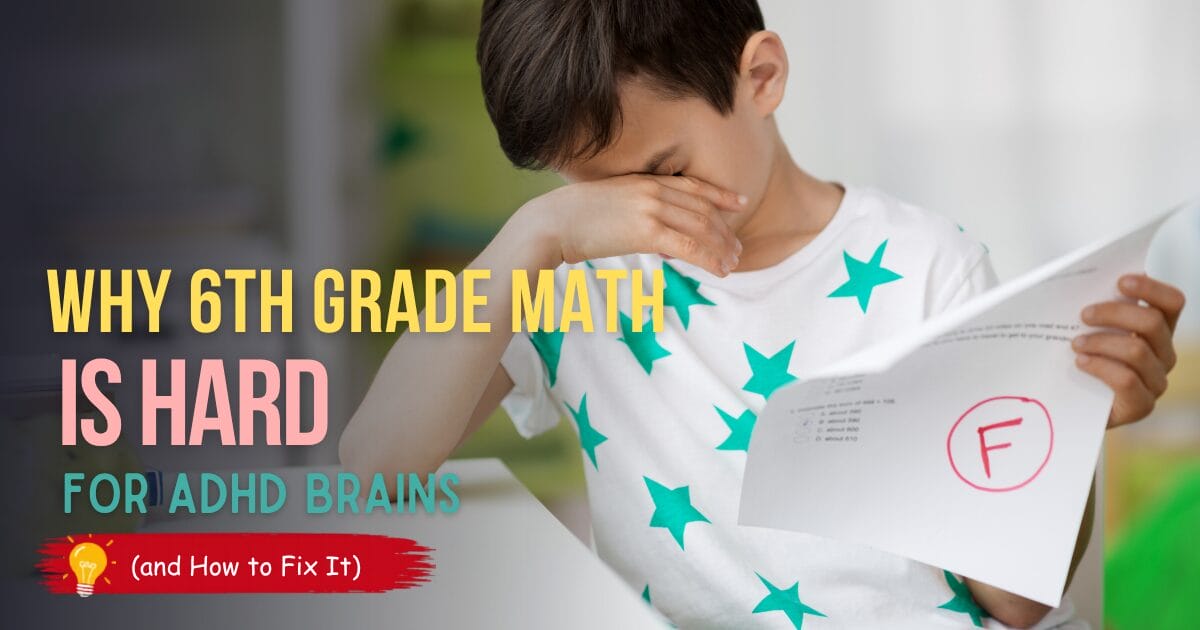
The jump into 6th grade is often described as a rite of passage, but for a student with attention deficit hyperactivity disorder, it can feel more like running headfirst into a brick wall. This year marks a fundamental shift in how mathematics is taught and processed. It is the bridge between the foundational “how-to” of elementary school and the conceptual “why” of high school algebra. For a brain that struggles with focus, organization, and working memory, this transition demands more than just extra practice—it requires a total strategy overhaul.
If you are a parent or teacher watching bright children with ADHD suddenly crumble under the weight of fractions and variables, know this: the struggle isn’t a lack of intelligence or effort. It is a mismatch between the 6th-grade curriculum and the ADHD brain’s executive functioning. By understanding why this “wall” exists, we can start building the ramps our students need to climb over it.
The 6th Grade Math Wall: Why It Hits ADHD Students Harder
In elementary school, math is largely procedural, often centered on rote memorization. You memorize your times tables, you learn long division, and you follow a set of steps to get an answer. But in 6th grade, the game changes.
The Transition from Concrete to Abstract
Up until now, math has been tangible. If you have three apples and take one away, you have two. But 6th grade introduces variables ($x$ and $y$), negative numbers on a number line, and ratios. Suddenly, math isn’t about apples anymore; it’s about relationships between symbols. For an ADHD learner, who often relies on vivid, concrete imagery to ground their thoughts, these abstract concepts can feel like trying to grab smoke with their bare hands. Without a physical anchor, the brain struggles to keep the information from drifting away.
The Executive Function Gap
Middle school requires a massive upgrade in “brain management,” also known as executive function. Students are suddenly expected to track multiple teachers, keep a color-coded binder, and remember that “the homework is on page 42, but only the even numbers.” For an ADHD student, the mental energy required just to start the assignment often exhausts them before they even solve the first problem. The 6th-grade math wall isn’t just about the math; it’s about the logistical nightmare of managing complex math problems.
The “Big Three” Hurdles for ADHD Learners in 6th Grade
While the curriculum is vast, three specific areas tend to trigger the most frustration for ADHD students.
1. Multistep Complexity (The Working Memory Trap)
Think of working memory like a mental sticky note. In 6th grade, that sticky note needs to be huge. Solving an expression with the Order of Operations (PEMDAS) requires holding the result of one calculation in your head while performing the next, all while remembering the rules of the sequence. For an ADHD student, that mental sticky note often loses its stickiness. They might correctly multiply 4 by 5, but by the time they go to add the next number, they’ve forgotten what the product was. This leads to “careless errors” that aren’t actually about carelessness—they are often a result of impulsivity or a working memory overload.
2. Deciphering Word Problems (The Focus Tax)
Word problems in 6th grade become linguistic puzzles. They are filled with “distractor” information—extra numbers or narrative details that have nothing to do with the math. For a student with an inattentive focus filter, every word in the problem carries equal weight. They get bogged down in the story of why Sally is buying 47 watermelons rather than identifying the operation needed to solve the problem. This “focus tax” makes word problems feel like an insurmountable mountain of text.
3. Transitioning to Ratios and Proportions (The Visual Struggle)
Ratios are all about scale and perspective—concepts that are inherently visual, much like interpreting graphs. However, the way they are taught is often purely numerical. When an ADHD student can’t “see” how one part relates to the whole, the numbers feel arbitrary and they struggle to develop a strong number sense. They might understand that a ratio is 2:3, but they struggle to apply that when the total changes, because they haven’t internalized the visual “blueprint” of the relationship.
Strategies to Bridge the Gap at Home and School
To help an ADHD student succeed, we have to move the work from the invisible space of their mind into the visible, physical world.
Externalize the Process with Visual Aids
Since we know working memory is a bottleneck, we must stop asking the student to “do it in their head.” Every step should be externalized. This means using highlighters to color-code different parts of an equation or using “cheat sheets” that list the steps of a process (like how to divide fractions) right on their desk. When the rules are visible, the brain doesn’t have to waste energy trying to remember them and can focus entirely on the problem solving process.
The Power of “Think-Alouds” and Body Doubling
ADHD students often benefit from “Think-Alouds,” where the teacher or parent narrates their internal logic: “First, I’m looking for parentheses. I see them here, so I’ll do this part first…” This models the “internal monologue” that many ADHD students haven’t developed yet. Additionally, the concept of “body doubling”—simply sitting in the same room while the student works—can provide a grounding presence that keeps them on task without a single word being spoken.
Gamification Without the Distraction
Gamification is a double-edged sword. While it can provide the dopamine hit ADHD brains crave, it can also become a distraction. The goal is to find games that reward the math, not just the speed. Look for platforms that allow for “boss battles” or leveling up through accuracy. If a game is too flashy, the student may focus on the graphics and ignore the underlying logic.
The Best Educational Resources for ADHD Math Success
Not all resources are created equal. For 6th graders, the best tools are those that provide immediate feedback and sensory engagement.
Interactive Digital Platforms
- Khan Academy: Its mastery-based system is excellent because it allows students to fill in gaps from previous years without shame. The immediate “ding” of a correct answer provides a hit of dopamine that keeps them engaged.
- DragonBox Algebra 12+: This app turns algebraic logic into a puzzle game. It’s perfect for the 6th-grade transition because it removes the “scary” numbers and focuses on the rules of the system first.
Hands-On Manipulatives for Middle Schoolers
Don’t pack away the blocks just because they’re in middle school. Use Algebra Tiles to represent variables and constants. Use Fraction Circles to visualize ratios. When a student can physically move a “tile” to the other side of an equal sign, the abstract concept becomes a concrete action.
Specialized ADHD Tutoring and Coaching
General math tutors often focus on the “what.” ADHD coaches focus on the “how.” If you seek outside help, look for someone who understands executive functioning. A tutor who helps a student organize their notebook and plan their study breaks is often more valuable than one who just explains how to find a common denominator.
Advocating for Your Child: Accommodations That Actually Work
An IEP or 504 plan is only as good as the specific accommodations within it. For 6th-grade math, focus on these high-impact changes.
Breaking Down Assignments into “Micro-tasks”
A 20-problem worksheet is a nightmare for an ADHD student. An accommodation can be as simple as the teacher cutting the worksheet into four strips of five problems each. Completing a strip feels like a “win,” providing the momentum needed to start the next one.
The Use of Calculators as a Cognitive Scaffold
Many 6th-grade teachers resist calculators because they want students to practice basic facts. However, if a student understands the concept of an area problem but gets it wrong because they made a basic multiplication error, we are testing their memory, not their math skills. Allowing a calculator for complex conceptual work prevents the student from getting demoralized by minor computational slips.
Adjusted Testing Environments
It’s not just about “extra time.” For many, it’s about a “distraction-free” environment. This doesn’t mean a silent room (which can actually be more distracting for some), but rather a space where they aren’t watching thirty other students flip their pages or finish early.
Shifting the Mindset: From “Bad at Math” to “Learning Differently”
The most dangerous thing a 6th grader can believe is that they are “not a math person.” This identity often forms during this difficult year. We must frame their struggles as a design flaw in the curriculum or a specific learning disability, not a flaw in their character. Celebrate the “ADHD superpowers”—like the ability to see patterns others miss, while remaining mindful of co-occurring challenges like dyscalculia, or the hyperfocus they bring to a challenging logic puzzle. When a student understands that their brain simply requires a different set of tools, the shame evaporates, leaving room for curiosity.
A Quick Checklist for Parents and Teachers
- Audit the Workspace: Is it clear of visual clutter? Is there a physical “formula sheet” visible?
- Check the “Start State”: Does the student know exactly what the first step is? If not, do a “Think-Aloud” for the first problem.
- Prioritize Quality Over Quantity: Would doing 5 problems perfectly be more beneficial than doing 20 problems with 15 errors? (Ask for this accommodation!)
- Celebrate the Process: Did they show their work? Did they catch a mistake? Reward the effort of the system, not just the final answer.
- Monitor the Battery: Recognize that math takes more “brain fuel” for an ADHD student. Schedule high-intensity math work when their focus is at its peak, usually earlier in the day or right after physical activity.