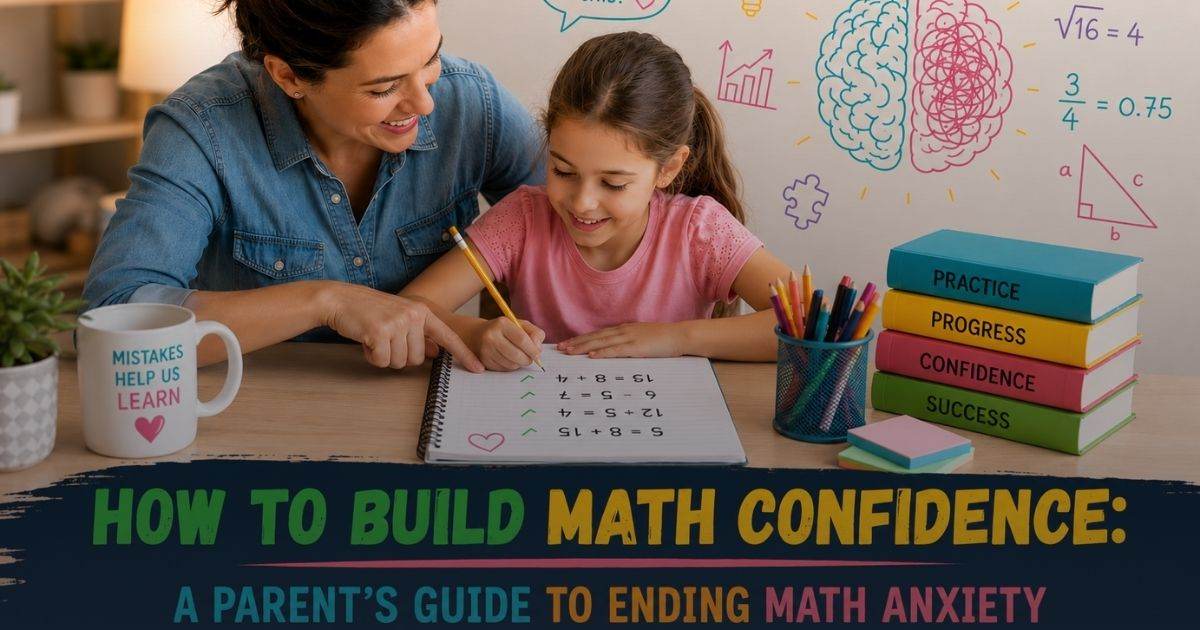


Let’s be honest: for many of us, the sight of a long-division bracket or a word problem involving two trains leaving different stations triggers a physical reaction. Maybe your palms get a little sweaty, or your brain suddenly feels like it’s made of cotton candy. If the thought of helping your child with their math homework or supporting their math skills throughout the school year makes you want to hide under the covers, I have a secret for you: You are absolutely not alone. We are in this together, hovering over the kitchen table, staring at common denominators like they’re ancient hieroglyphics.
We’ve All Been There: The “Math Person” Myth
We’ve been sold a lie for decades—the idea that you’re either born with a “math brain” or you aren’t. We treat mathematical ability like eye color; you either have it, or you’re destined to squint at the tip jar for the rest of your life. But here’s the truth: being a “math person” is a myth as flimsy as a one-ply paper towel.
It’s Okay to Admit You’re Terrified of Fractions
Can we just take a collective breath and admit that fractions are weird? They’re numbers stacked on other numbers, behaving in ways that feel deeply personal and intentionally confusing. If you feel a twinge of terror when your fourth-grader asks for help with “improper” fractions, give yourself some grace. It doesn’t mean you’re unintelligent; it just means you survived a math class that prioritized rote memorization over actual understanding. You aren’t failing your child by being confused; you’re just human.
Why Your Math Anxiety Might Be Influencing Your Child
Here’s the tricky part of the “I hate math” club: our kids are like little emotional sponges. If we approach the homework folder with the same enthusiasm we’d bring to a root canal, they notice. When we sigh, roll our eyes, or joke about how “we were never good at this,” we’re accidentally giving them a “get out of jail free” card to give up. We’re essentially saying, “Hey, this is impossible and miserable, so don’t worry if you fail.” While we want to maintain a positive attitude and be supportive, we might be inadvertently passing down our “math trauma” like a dusty family heirloom nobody actually wants.
The Power of “Yet”: Shifting the Mindset
The bridge between “I can’t do this” and “I’ve got this” is a single, three-letter word: Yet. It’s the smallest word with the biggest muscle.
Fixed vs. Growth Mindset in the Context of Numbers
A fixed mindset is like a concrete wall—it says, “I’m bad at math, and that’s that.” A growth mindset is more like a garden; it’s messy, it requires work, but things actually change. When your child says, “I don’t get it,” they’re describing a temporary state of being. By adding “yet” to the end of that sentence (“I don’t get it yet“), we shift the focus from a lack of ability to a work in progress. It turns a dead-end street into a highway under construction.
Validating the Struggle Without Agreeing with the “Defeat”
When your child is crying over a worksheet, the last thing they need is a lecture on the beauty of algebra. They need to know you see them. Try saying, “Man, this problem is a real beast, isn’t it? I can see why you’re frustrated.” Validating the emotion doesn’t mean you agree that they’ll never learn it. You’re acknowledging the mountain is steep, but you aren’t suggesting they stop climbing.
Turning Math into a Family Game (Not a Chore)
If we only ever encounter abstract math concepts in the form of a black-and-white worksheet, of course we’re going to hate it. Math in the wild and in daily life is actually pretty cool—and dare I say, fun?
The Kitchen: A Laboratory for Measurement and Fractions
The kitchen is the ultimate math classroom, and the best part is that you get cookies at the end. Want to teach fractions? Ask your child to help you double a recipe that calls for 3/4 cup of flour. Watch their brain work as they realize they need to scoop that 1/4 cup six times. It’s tactile, it’s messy, and it smells like vanilla. That’s “sneaky math” at its finest.
Board Games and Puzzles: Stealth Math in Action
Board games are just math dressed up in a party hat. Yahtzee is pure probability and addition. Monopoly (if you can survive the family feud) is a masterclass in budgeting and mental subtraction. Even simple card games like War or Go Fish build early math number sense and math number fluency. When the stakes are “beating Mom at cards,” kids suddenly become human calculators.
Sports and Grocery Stores: Real-World Word Problems
The grocery store is a goldmine for mental math. “We have $20; can we afford three boxes of cereal and a gallon of milk?” Or, if you’re watching a game: “Our team is down by 14 points. How many touchdowns do they need?” These aren’t just “math problems”—they’re real-life, real-world problem-solving puzzles. By framing them this way, we strip away the academic pressure and replace it with curiosity.
Actionable Strategies for the “I’m Stuck” Moments
When the inevitable “wall” happens—and it will—here is your survival guide for getting through the next twenty minutes without anyone (including you) bursting into tears.
1. Become the “Co-Learner” Instead of the “Expert”
You don’t have to be the sage on the stage. In fact, it’s better if you aren’t. When your child is stuck, say, “You know, I actually forget how to do this part. Let’s look at the example together and see if we can decode it.” This removes the “teacher-student” hierarchy and turns you into a team of detectives solving a mystery.
2. Focus on the Process, Not Just the Answer
In the real world, the “right” answer matters. In learning, the thinking matters more. If they get a problem wrong, don’t just erase it. Ask, “How did you get there? Walk me through your brain’s path.” Often, they’ll find their own mistake halfway through the explanation. Celebrate the “how” more than the “what.”
3. Use Visual Aids and Tactile Tools (Manipulatives)
Math is often too abstract. It’s just squiggles on a page. Bring it into the 3D world. Use LEGO bricks to show multiplication arrays. Use dried beans for counting. Use a pizza (or a drawing of one) to visualize percentages. When their hands are moving, their brain is often more open to receiving information.
4. The “Brain Break” Rule: When to Walk Away
If the steam is starting to come out of their ears—or yours—it’s time to call it. High cortisol levels (the stress hormone) literally shut down the part of the brain responsible for logical thinking. You cannot learn math while in “fight or flight” mode. Take ten minutes to jump on a trampoline, pet the dog, or have a dance party. The math will still be there when the adrenaline fades.
How to Talk About Math Without the Cringe
The language we use in our homes becomes the inner monologue of our children. Let’s make sure that monologue isn’t a jerk.
Banishing “I’m Just Not a Math Person” from Your Vocabulary
We’re officially retiring this phrase. Instead, try: “Math was a challenge for me, so I’m working on it right along with you.” This models resilience rather than resignation. It shows that struggle is a natural part of life, not a sign of a broken brain.
Celebrating Mistakes as “Brain Growing” Opportunities
Mistakes aren’t failures; they’re data points. When a mistake happens, literally say, “Ooh, your brain just grew a little bit! You found a way that didn’t work, which means you’re closer to the one that does.” It sounds cheesy, but reframing errors as “sparking synapses” takes the sting out of being wrong.
Choosing the Right Support Systems
You don’t have to carry the entire weight of the curriculum on your shoulders. It takes a village, and that village includes people who actually like calculus.
Communicating with Teachers Without Feeling Intimidated
Teachers are your allies, not your judges. If the homework is taking two hours and ending in sobs, send an email. “Hey, we struggled with the concept of regrouping last night. We spent 30 minutes on it and decided to stop for sanity’s sake. Can you check in with [Child’s Name] tomorrow?” Most teachers will thank you for the heads-up.
Apps and Online Resources That Don’t Feel Like Homework
Sometimes, a different voice helps. Sites like Khan Academy or apps like Prodigy (which is basically a video game powered by math) can explain things in ways we can’t. Let the computer be the “bad guy” or the “teacher” for a while so you can just be the “supportive snack-bringer.”
The Big Takeaway: You’re Doing Better Than You Think
At the end of the day, your child isn’t going to remember that you forgot those high school lessons on how to find the area of a trapezoid. They are going to remember that you sat with them. They’ll remember that you didn’t give up on them, even when the numbers felt like they were winning.
Permission to Prioritize Connection Over Correctness
If a math assignment is destroying your relationship with your child, put the pencil down. Your connection is infinitely more important than a worksheet. You have full permission to prioritize a peaceful evening over a completed set of long division problems. A child who feels safe and loved will eventually learn math; a child who feels shamed and pressured will learn to hate it.
A Final High-Five for the Brave Parents
So, here is your digital high-five. You are doing the hard work of breaking cycles of anxiety and building math confidence through positive math learning in your child. You are teaching your child that being “smart” isn’t about knowing all the answers—it’s about having the courage to keep asking the questions. You’re more than a “math person” or a “non-math person.” You’re a parent, a coach, and a co-adventurer. And in my book, that makes you a genius.