

Mathematics is often described as a universal language, but for many students, it feels more like a locked door without a key. Whether it is a third-grader struggling with the mechanics of long division or a high school junior staring down the complexities of trigonometric identities, the frustration is real. When a student hits a roadblock in math, it rarely stays confined to the classroom; it spills over into homework battles at the kitchen table and a dwindling sense of academic confidence.
The search for professional tutoring isn’t just about chasing an “A.” It is about finding a mentor who can translate the abstract into the understandable and turn confusion into competence. In this guide, we will explore how personalized math help serves as the catalyst for student success, dismantling the barriers that hold learners back.
The Challenge of the “Math Wall” and Why One-Size-Fits-All Fails
Every student eventually hits what educators call the “Math Wall.” This is the point where the intuitive understanding of numbers no longer suffices, and the complexity of the subject scales faster than the student’s current toolkit. In a traditional classroom, a teacher is tasked with delivering a standardized curriculum to thirty different minds simultaneously. Because math is inherently cumulative—meaning you cannot build the roof of a house before the foundation is poured—missing even one small math concepts in October can lead to a total collapse in January.
One-size-fits-all instruction fails because it prioritizes the calendar over the student. If the class moves on to fractions while a student is still shaky on multiplication, that student isn’t just “behind”—they are essentially being asked to read a novel without knowing the alphabet. Personalized support identifies exactly where that foundation cracked and repairs it before moving forward.
Why Personalized Math Help is the Modern Student’s Secret Weapon
Think of a personal math tutor as a GPS for a journey through a dense forest. While a classroom teacher provides the map, the tutor stands beside the student, recalculating the route every time they take a wrong turn. This individualized attention transforms the learning experience from a passive reception of facts into an active, engaging dialogue.
Moving Beyond Rote Memorization to Conceptual Clarity
Many students “survive” math by memorizing formulas. They know that a² + b² = c², but they couldn’t tell you why it works or how it applies to the real world. This reliance on rote memorization is a house of cards. Personalized tutoring shifts the focus from “how to get the answer” to “why the logic holds.” When a student understands the concept of proportionality, they don’t need to memorize a dozen different shortcuts for percentages, ratios, and slopes; they simply see the underlying pattern.
Addressing “Math Anxiety” Through Safe Learning Spaces
Math anxiety is a documented psychological phenomenon where the brain’s “fight or flight” response shuts down working memory. It’s hard to solve for x when your heart is racing and you’re terrified of looking foolish in front of peers. A one-on-one environment removes the audience. It creates a safe space where “I don’t know” is a starting point, not a confession. This psychological safety allows students to take risks, ask “dumb” questions, and eventually replace panic with a sense of calm control.
Bridging the Gap Between Classroom Pace and Individual Progress
The modern school system is a conveyor belt. It moves at a set speed regardless of who is falling off the sides. Personalized help acts as a “pause” button. If a student needs three weeks to master the unit circle but the curriculum only allows three days, a tutor provides the supplemental time necessary to achieve mastery. Conversely, for students who are bored by the slow pace of school, a tutor can provide the acceleration needed to keep their curiosity alive.
Targeted Support Across the Educational Journey
Mathematics isn’t a single subject; it’s a progression of logic that evolves as a student grows. The support required for a seven-year-old is fundamentally different from the needs of a college sophomore.
Elementary School: Building a Rock-Solid Foundation of Number Sense
In the early years, elementary math is about “number sense”—the intuitive understanding of how quantities relate. Professional tutoring at this level often looks like play. Tutors use manipulatives and visual aids to ensure the student isn’t just reciting facts but “seeing” the math. If a child masters the foundational logic of place value and basic operations now, they won’t struggle when those concepts become the background noise of more difficult problems later.
Middle School: Navigating the Transition to Abstract Reasoning and Algebra
Middle school is often where the wheels come off. This is the transition from the concrete (3 + 4 = 7) to the abstract (3x + 4 = 19). For many students, the introduction of variables feels like an unwelcome invasion of letters into a world of numbers. Specialized tutoring during these years focuses on bridge-building—helping students move from physical representations to symbolic logic. Mastering Algebra I is arguably the most critical milestone in a student’s math career, as it serves as the gatekeeper for all future STEM success.
High School: Mastering Complex Calculus, Geometry, and Advanced Functions
By high school, the stakes rise. Geometry requires logical proofs, while Calculus demands an understanding of infinite change. At this level, a tutor acts more like a high-level coach. They help students navigate the “why” behind the derivative or the nuances of a sine wave. High school tutoring also focuses on organizational skills—teaching students how to show their work systematically so they can debug their own problem-solving errors during a test.
College Level: Specialized Support for Statistics and University-Level Mathematics
Even high-achieving students often find themselves humbled by university-level math. Whether it’s the rigorous proofs of Linear Algebra or the data-heavy world of Business Statistics, college math moves at a blistering pace. One-on-one training at this level is highly specialized, often focusing on specific applications in engineering, economics, or social sciences.
Strategic Test Prep: Turning Stress Into Success
Standardized tests are a unique beast. They don’t just test what you know; they test how well you play the game.
Cracking the Code: Specialized Tutoring for the SAT and ACT
The math sections of the SAT and ACT are designed to be tricky. They use familiar concepts but frame them in unfamiliar ways to test a student’s “mathematical flexibility.” A professional test-prep tutor teaches the “code.” They show students how to identify “distractor” answers, when to plug in numbers, and how to manage their time so they aren’t rushing through the final five problems.
AP and IB Exam Prep: Securing College Credit with Confidence
Advanced Placement (AP) and International Baccalaureate (IB) exams are grueling, multi-hour assessments that can save families thousands of dollars in college tuition. Success here requires a deep dive into previous exam patterns and rubrics. Targeted prep ensures students aren’t just doing the math, but presenting it in the specific format that graders demand.
Finding the Right Fit: One-on-One vs. Group Sessions
The environment in which a student learns is just as important as the material being taught.
The Power of Undivided Attention in One-on-One Tutoring
In a group of even four or five, a student can hide. In a one-on-one session, there is nowhere to retreat. The tutor is constantly monitoring the student’s “micro-signals”—a furrowed brow, a hesitation before writing, or a sigh of frustration. This allows the tutor to intervene in real-time, correcting a misconception the very second it appears. This level of focus is the fastest way to close a learning gap.
Identifying Your Student’s Learning Style (Visual, Auditory, Kinesthetic)
Everyone processes information differently. A visual learner might need to see color-coded equations to understand the distributive property. An auditory learner might need to talk through the logic of a word problem out loud. A kinesthetic learner might need to physically move objects to grasp geometric volume. A professional tutor identifies these preferences early and tailors their delivery accordingly.
What to Look for in a Professional Math Tutoring Service
Not all tutoring is created equal. When searching for a service, look beyond the price tag.
Expertise vs. Relatability: Finding the Right Mentor
A tutor needs to know the material, but being a math genius doesn’t automatically make someone a great teacher. In fact, some of the best tutors are those who once struggled with math themselves. You are looking for a mentor who can empathize with the frustration and explain a concept in three different ways until one finally “clicks.”
Customized Curriculum and Adaptive Learning Platforms
The best services don’t use a “book for everyone.” They use diagnostic tools like ALEKS to pinpoint exactly where a student’s knowledge ends and their confusion begins. This data-driven approach ensures that no time is wasted on concepts the student has already mastered.
Measurable Progress: How to Track Real Improvement
Tutoring shouldn’t be an endless black hole of time and money. Look for services that offer regular progress reports, practice assessments, and clear milestones. You should see a direct correlation between tutoring sessions and improved performance on school quizzes and tests.
The Role of Online vs. In-Person Math Support
The “where” of tutoring has changed dramatically in recent years. Both formats offer distinct advantages.
The Flexibility and Tools of Modern Digital Tutoring
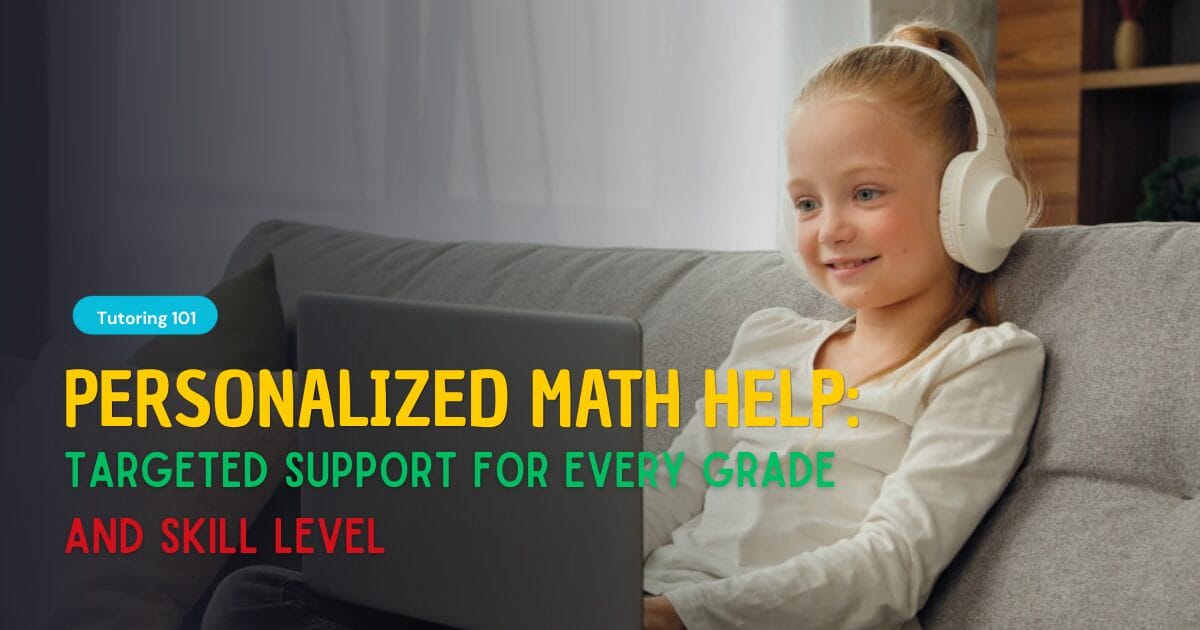
Online tutoring has evolved far beyond a simple video call and static video lessons. Modern platforms feature interactive whiteboards where both student and tutor can write simultaneously, session recording features for later review, and the ability to connect with world-class specialists who might live three time zones away. For a busy student balancing sports and extracurriculars, the convenience of logging in from home is a game-changer.
The Focused Environment of In-Person Learning
For some students, the physical presence of a tutor is essential for maintaining focus. The tactile experience of working on paper, the lack of digital distractions (like notifications or open browser tabs), and the personal connection of being in the same room can lead to deeper engagement for those who find “screen fatigue” a real obstacle.
Practical Next Steps to Boost Math Performance Today
If you’re ready to see your student’s confidence soar, the first step is a diagnostic assessment. This isn’t a “test” to be feared, but a roadmap to be followed. Once you know where the gaps are, you can match your student with a mentor who fits their personality and academic needs. Don’t wait for the next failing grade to act; proactive support is always more effective than crisis intervention.
Frequently Asked Questions About Personalized Math Help
How long does it take to see an improvement in grades?
While every student is different, most parents see a shift in “attitude” within 4 sessions and a measurable improvement in quiz scores within 6 to 8 weeks. The goal is to first stop the “downward slide” before beginning the climb toward higher grades.
Can tutoring help a student who is already doing well?
Absolutely. High-performing students often use tutoring to stay ahead of the curve, prepare for competitive math competitions, or master advanced topics that their school doesn’t offer. It’s about reaching one’s full potential, not just avoiding failure.
What is the ideal frequency for tutoring sessions?
For most students, two sessions per week is the “sweet spot.” It provides enough consistency to build momentum without overwhelming the student’s schedule. Once a student becomes more confident, this can often be scaled back to once-a-week “maintenance” sessions.

